
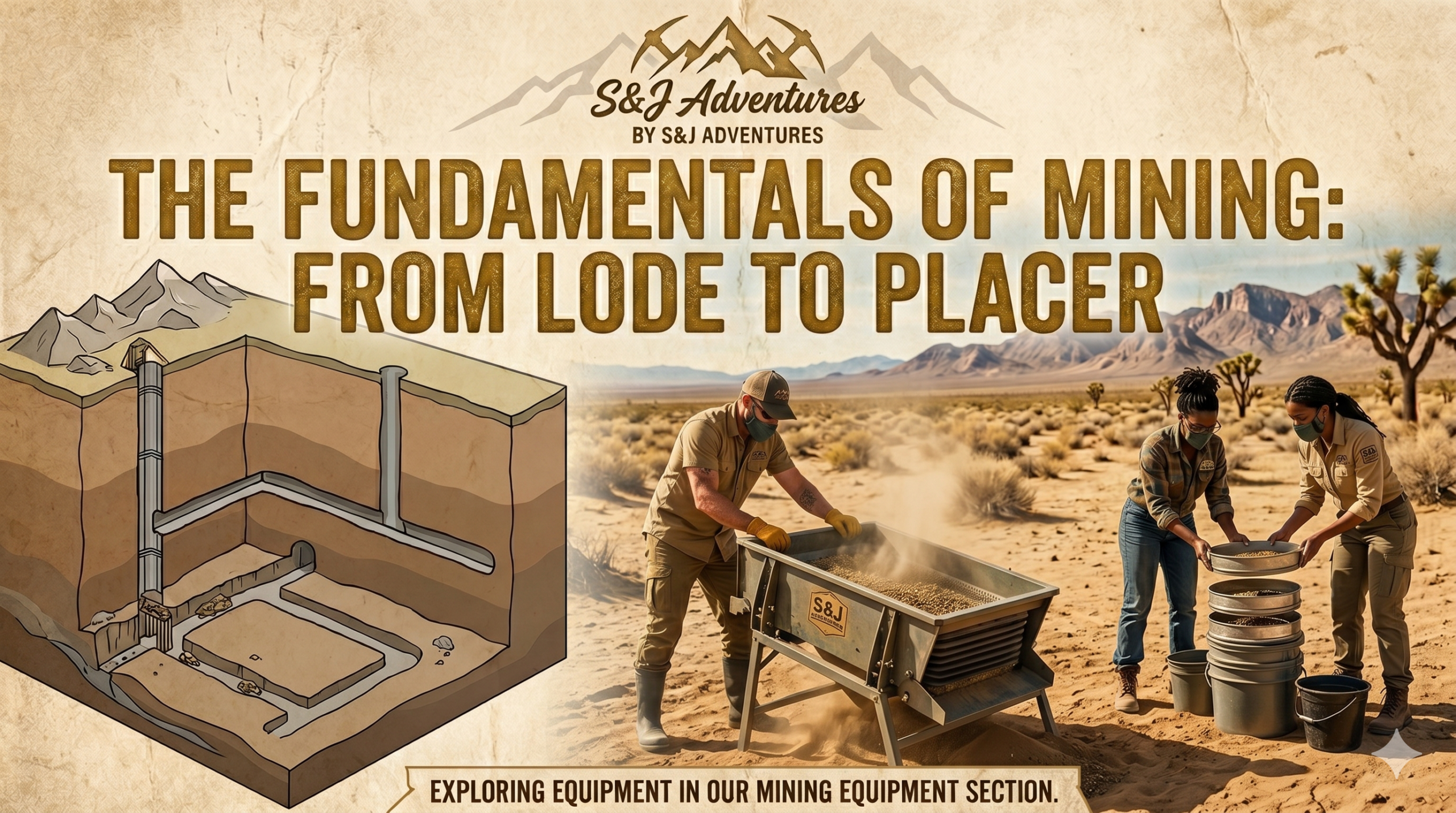
The Fundamentals of Mining: From Lode to Placer
By S&J Adventures
What is Mining?
At its core, mining is the process of extracting coal, ores, or other valuable minerals from the earth. Whether conducted on a private claim or public land, mining involves the systematic excavation of geological materials to recover profit-bearing resources.
Mining techniques are generally categorized into two main branches:
- Surface Mining: Extracting minerals near the earth’s surface.
- Underground Mining: Utilizing shafts and tunnels to reach deep-seated deposits.
While industrial mining utilizes massive machinery, S&J Adventures focuses on the equipment and techniques used by smaller-scale and recreational miners.
1. Lode Mining (Hard Rock Mining)
Lode mining involves extracting minerals directly from solid rock veins. This is the primary method used to recover the majority of the world’s gold supply.
- Process: Miners must drill and blast into solid rock to reach the raw ore.
- Infrastructure: Operations often require vertical shafts or horizontal tunnels (adits) supported by large timbers to prevent cave-ins. Headframes and hoists are used to transport material to the surface.
- Challenges: This method is labor-intensive, dangerous, and expensive. As mines descend toward the water table, constant pumping is required to prevent flooding.
- Verdict: Due to high startup costs, most recreational miners stick to placer deposits.
2. Placer Mining
Placer mining targets alluvial deposits—gold, gems, and heavy metals that have been eroded from their original source and deposited in sand or gravel by water flow or glacial movement.
The Science of the Settle
Because gold is significantly denser than the surrounding sand and gravel, it naturally settles at the lowest point of a deposit, often resting on bedrock.
Hydraulic Mining
When high-pressure water is available, it can be used to wash entire hillsides into sluice boxes. This is known as hydraulicking. While efficient for moving mass amounts of material, it is heavily regulated today due to its environmental impact.
3. Gold Panning
Panning is the most iconic and accessible form of mining. Dating back to the 1840s, it remains a foundational skill for every prospector.
- How it Works: Using water, a miner agitates gravel in a pan to wash away lighter dirt. The “heavies”—including black sand, lead, and gold—concentrate at the bottom.
- The Golden Rule: Regardless of your primary recovery method (dredging, high-banking, or sluicing), the final step of cleaning your concentrates almost always requires a gold pan.
4. Dry Washing
In arid desert climates where water is scarce, miners use Dry Washing to recover gold.
- Mechanism: A dry washer uses a bellows or blower (hand-cranked or motorized) to vibrate a recovery tray. The air pulse mimics the action of water, allowing heavy gold to settle behind riffles while lighter dust blows away.
- Limitations: The material must be perfectly dry. If the ground is damp, the “paydirt” must be spread out on a canvas to dry in the sun before processing.
- Efficiency: It is less efficient than water-based methods because gold is harder to see when coated in dust, and air is a less effective medium for density separation than water.
5. Suction Dredging
Dredging is the most effective method for modern placer mining in active or ancient streambeds.
- The Suction Dredge: Small-scale miners use a gasoline-powered pump to create a vacuum. This sucks up water, gravel, and gold through a hose.
- The Process:
- Material enters a header box, which slows the water velocity.
- The slurry flows over a sluice box.
- Riffles in the sluice trap the heavy gold while the “tailings” (worthless gravel) are washed back into the stream.
- Support Equipment: Miners often use jib cranes to move large boulders that are too heavy to lift by hand, clearing the way to reach the rich “pay” on the bedrock.
Looking for the right gear to start your journey? Check out our Mining Equipmentsection for reviews and guides on the best tools for the field.