
Field Log: When a Gladiator Alternator Dies, the Entire Rig Goes Insane
You drive a rig long enough through the desert, and eventually, the desert hits back. This week, the failure point wasn’t on a remote trail in the Mojave Desert, but right in the middle of a midday asphalt run that escalated into a full-scale electrical mutiny.
The Initial Warning
On Monday, June 1, 2026, I drove GrayBeard to work for a standard shift. During the lunch block, Samantha and I headed out to grab a quick meal at Arby’s. Everything was running normally until the return leg of the trip.
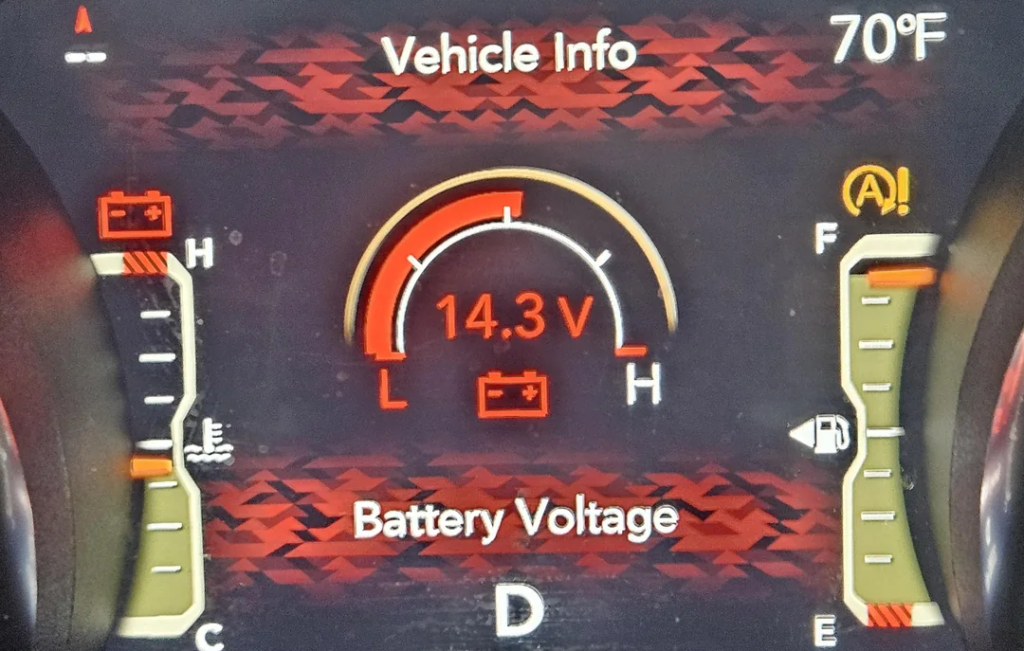
Less than a block away from the school, a hard warning triggered on the main instrument cluster. The entire digital dashboard turned bright red, flashing a critical Battery Voltage error across the screen. Knowing the school gates were within sight, I kept my foot down and finished the drive to the campus parking lot before shutting down.
The Commute Home: Total System Mutiny
When the shift ended, I climbed back into the cab, temporarily forgetting the midday voltage alert. I fired up the engine and headed home.
I made it about five blocks up the road—exactly one block past the local Jeep dealership—before the Gladiator became completely possessed. Because modern vehicles rely entirely on tightly regulated voltage networks to communicate between control modules, dropping below critical thresholds causes the computer systems to fail sequentially:
- The Auto Start-Stop system cut out entirely.
- The windshield wipers turned themselves on high speed without input.
- The engine lost 98% of its propulsion power, dropping into a severe limp-mode strategy.
I managed to limp the truck off the main road into a nearby parking lot. The moment I rolled into a space, the wheels locked up completely, and the electronic shifter refused to transition into Park.
The 200W Solar Rescue
I popped the hood and put a meter on the primary battery. It had dropped down to 10.8V instead of the standard 14.4V a healthy charging system should be maintaining.
Fortunately, I have a 200-watt solar panel mounted on top of my rooftop tent (RTT). I rigged the solar controller output directly to the main battery terminals to harvest enough sun power to get the voltage up. The goal was to limp the truck exactly one block back down the street to the dealership.
It was a brutal, incremental crawl. The Gladiator could only travel about 1,000 yards before the voltage cratered and the computer systems went wild again. I pulled over, let the solar panel dump juice back into the cells under the sun, and pushed forward for the final stretch. I rolled up to the dealership service bay door just as the transmission locked up solid and the electronic parking brake automatically engaged itself right on the pad.
The Diagnostic and the Pentastar Premium
The service department confirmed the diagnosis: the auxiliary and primary batteries were fine, but the alternator was completely dead.
If you’ve ever changed an alternator on a standard truck, you’re probably used to a $200.00 bill for the part. The high-output alternator required for the 3.6L Pentastar V6 inside the Jeep Gladiator is a completely different tier of expense. The replacement unit runs well over $800.00, with an additional $75.00 core charge tacked on top.
I am currently waiting to get the rig cleared from the shop bay. We have high-priority overlanding and prospecting trips mapped out for this weekend, so the turnaround timing needs to be absolute.
Step-by-Step Recovery Checklist for a Dead Gladiator Alternator
If your dashboard turns red and your voltage drops to 10.8V in a Gladiator, here is the survival protocol:
- Do Not Shut the Engine Off Until Safe: The moment you turn the key off on a depleted battery, the starter solenoid will not click back over. Keep the engine running to extract the final remaining amps from the battery cells to get off the active roadway.
- Override the Shift Lockout: If your transmission locks up and refuses to go into Park or Neutral, remove the small plastic access trim piece next to the gear selector to manually trip the mechanical bypass lever.
- Isolate the Batteries: The Gladiator utilizes an auxiliary battery system tucked under the main fuse box. When the alternator dies, one bad battery can actively drain the other. Disconnect them independently if you need to trace whether a single shorted cell is dragging the alternator’s voltage regulator down into a failure state.